
Safety and Health Initiatives
At the Unitika Group, the Central Safety and Sanitation Committee is implementing health and safety activities aimed at eliminating accidents that require time off from work at all production sites and affiliates. We hold safety and sanitation managers meetings three times a year for those Group employees in charge of safety and sanitation.
Unfortunately, in FY2023, there were 11 lost-time injuries, and the lost time injury frequency rate was 2.29, which we recognize as a very high value.
In FY 2024, we conducted a survey on safety measures for large roller equipment where serious accidents can occur, and we revised the inspection status and work procedures for safety devices and provided safety education.
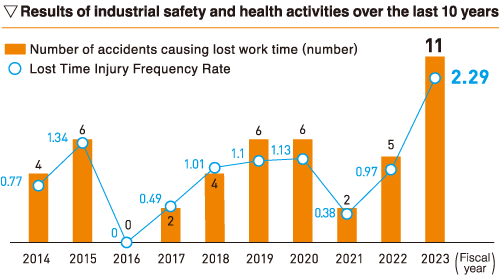
(Note)The reporting range
Before FY 2018: All main domestic production sites FY 2019 to FY 2022: All domestic Group companies From and Including FY 2023 actual result: entire Group, including overseas companies
KPIs of Priority Issues (Materiality)
Lost Time Injury Frequency Rate
(entire Group, including overseas companies)
FY 2030 target: 0.25
FY 2024 actual results: 1.05
Dialogue with Employees
Each business site holds monthly meetings of Health and Safety Subcommittees at the department level and the Health and Safety Committee at the site level, where dialogue is conducted between employees and the top management of the site or department. The Committees share information on occupational accidents that have occurred within the Group, and report on matters identified during on-site patrols, the status of improvements, near-misses, and other matters. The Uji Plants also have “Hazard Simulation Training Facilities,” where new employees can simulate being entangled in or crushed by machinery and learn the importance of protective equipment.
Disaster Prevention and Readiness Initiatives
Central Disaster Readiness Committee
The Central Disaster Readiness Committee is chaired by man Resources and General Affairs Department, and consists of 12 members, including three Executive Officers; the general managers of the Legal & Compliance, Information Systems, and Procurement & Logistics Departments; the general manager of the Business Planning & Administration Department of the Group company Unitika Trading Co., Ltd., the office managers of the Osaka and Tokyo Head Offices, and the general managers of the Uji and Tarui Plants.
The Committee is responsible for confirming the current status of disaster prevention organizations and activities, as well as for formulating and promoting the implementation of advance measures and providing guidance, in order to minimize damage to employees and facilities caused by disasters such as major earthquakes.
Strengthening of Disaster Prevention and Readiness Measures
To prepare for major disasters like the earthquake and tsunami that devastated Tohoku in March 2011, disaster readiness measures are crucial both to fulfill the basic mission of protecting the lives of employees, as well as to uphold the responsibility to stakeholders of continuing business activities. In July 2021, we revised the Unitika disaster prevention and readiness measures outline, and prepared a disaster prevention and readiness system and disaster control measures. Also in October 2024, the Central Disaster Readiness Committee held its FY 2024 Disaster Prevention Committee meeting to make the entire company aware of the importance of disaster prevention and readiness.
Additionally, as internal standards for managing safety at production facilities, Unitika has established a set of “pre-evaluation policies” on safety sanitation and environmental effects at new facilities. As a disaster readiness measure when creating or renovating facilities, a total of two rigorous inspections (during design and upon completion) are carried out in compliance with these standards.
Disaster Readiness Training
Unitika is actively carrying out accident and natural disaster training, as well as doing drills at production sites in the spring and autumn seasons of fire prevention activities. At 13:00 on Tuesday, October 22, 2024, the Tarui Plant conducted an emergency response and evacuation drill based on a simulated alert of a massive earthquake from the Early Earthquake Warning System. All 171 personnel on site, including contractors, participated in the drill. In addition to employees, on-site contractors were present and also participated in the evacuation drill. Based on a scenario where a fire started in the kitchen of the dining hall, selected members carried out initial firefighting during the drill.
At the Okazaki Plant, about 400 employees participated in integrated fire prevention and disaster prevention drills on November 18, 2024. In addition to evacuation drills in preparation for an earthquake, we partnered with the head office squad and district squads to carry out drills in preparation for a variety of crises including emergency rescue, the outflow of chemicals, fire breakouts, and the confinement of employees. In addition, on September 9, 2024, a whole-site training was conducted for one of the three shifts (36 employees), and remaining was conducted by each department and group for the other shifts.
At the Uji Plant, 544 employees participated in a whole-site disaster prevention and readiness drill on March 12, 2025. Shakeout drills were conducted in each department, followed by evacuation drills to primary and tertiary evacuation sites, as well as a safety confirmation drill.
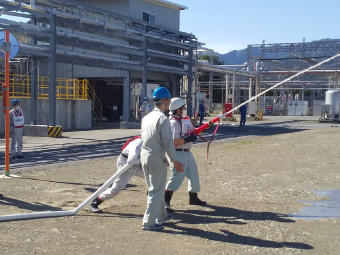
FY 2024 disaster prevention and readiness drill (Tarui Plant)
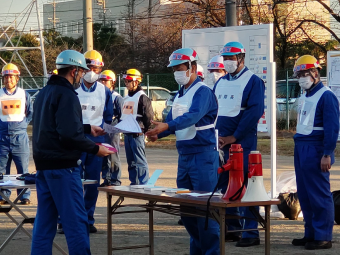
FY 2024 disaster prevention and readiness drill (Okazaki Plant)
Preparation for Large-Scale Disasters
The Unitika Group has established the Protocols for Returning Home, which encourages employees to stay at their workplaces if trains and other public transportation stop running due to large-scale disasters. This is to prevent employees from having difficulties in returning home, and to prevent them from obstructing the operations of police officers and fire fighters. We are also making other preparations such as storing disaster equipment, supplies, drinking water and preserved food. We have also established a system that allows us to handle requests for support from local residents in surrounding neighborhoods and for cooperation from local governments.